

If two businesses each report $2 million in turnover, should they sell for the same price? If your answer is yes, a revenue shortcut has already misled you. Buyers don't buy sales. They buy the cash those sales leave behind, and how reliably it continues after you leave.
A business valuation based on turnover can give you a useful first range. It cannot give you a defensible price on its own.
How Business Valuation Based on Turnover Works
Business valuation based on turnover multiplies annual revenue by a revenue multiple drawn from comparable sales. Turnover means revenue, the sales your business records before costs. The formula is annual revenue × revenue multiple = estimated value.
Keep three terms separate. Estimated business value is an informed estimate under stated assumptions. Asking price is what you propose. Final sale price is what a specific buyer agrees to pay under actual financing, debt, tax, and deal terms.
The formula is the easy part.
Treat the output as a market cross-check. The multiple assumes your revenue is clean and repeatable, so before you trust it, you normalize the turnover figure, reconcile the result against cash flow, and test it against what a lender will finance. The same revenue can clear those checks at very different levels.
What the Benchmark Range Actually Shows
The BizBuySell industry benchmark data, covering businesses sold from Q3 2021 through Q2 2026, reports revenue multiples from 0.42x to 1.20x with an average of 0.67x. In a hypothetical example, $1 million of revenue at 0.67x implies about $670,000. At 1.20x, the same revenue implies $1.2 million. That spread matters more than the average.
Sector moves the answer further. The BizBuySell 2026 second quarter insight report lists distribution and wholesale at 0.2x to 0.5x and bootstrapped SaaS at 2.0x to 5.0x. Where a sector lacks a published range, judge it against the all-business average.
| Sector or benchmark group | Typical revenue multiple |
|---|---|
| All businesses sold on BizBuySell | 0.42x to 1.20x, average 0.67x |
| Retail businesses | Typically below the all-business average |
| Accounting, CPA and tax practices | Typically above the all-business average |
| Distribution and wholesale | 0.2x to 0.5x |
| Construction and trades | Typically below the all-business average |
| Professional services | Around to above the all-business average |
| Bootstrapped SaaS | 2.0x to 5.0x |
Use the range as a screen. A multiple inside your sector's band tells you a price is plausible. Whether your turnover deserves that multiple is a separate question, and our guide to how business valuation multiples work in practice explains why matching industry, period, and size comes before any multiplication.
Why Equal Turnover Can Produce Unequal Values
A revenue multiple prices each dollar of sales. A buyer pays for each dollar they can keep. Those are different questions, and confusing them is expensive.

The BizBuySell U.S. 2025 year-end recap reported an average revenue multiple of 0.69x and an average cash-flow multiple of 2.61x, based on reports analyzing closed sales and listings across approximately 50,000 businesses for sale and recently sold in the United States. At 0.69x, $2 million of turnover implies about $1.38 million before adjustments. To support that same value at 2.61x, the business needs $528,736 of annual cash flow.
Same Turnover Different Cash Flow Hypothetical Example
| Measure | Company A (hypothetical) | Company B (hypothetical) |
|---|---|---|
| Annual turnover | $2,000,000 | $2,000,000 |
| Revenue-based estimate at 0.69x average multiple | $1,380,000 | $1,380,000 |
| Assumed annual cash flow | $350,000, assumption 17.5% of turnover | $600,000, assumption 30% of turnover |
| Cash-flow-based estimate at 2.61x average multiple | $913,500 | $1,566,000 |
| Cash flow needed to support the revenue-based estimate at 2.61x | $528,736 | $528,736 |
What separates them isn't effort or years in business. It's profit margin, customer concentration, recurring revenue, debt, and the working capital each business consumes before owners see cash.
Period matters too. The same recap notes retail reached its highest average earnings and revenue multiples in 2025 since tracking began, while median retail revenue was 22% below its 2021 high. A multiple from the wrong year can flatter or punish you for market conditions you didn't create.
Normalizing Turnover Before You Apply a Multiple
Apply a multiple only to revenue a buyer could reasonably expect to continue. If the revenue won't transfer, it shouldn't be priced as if it will.
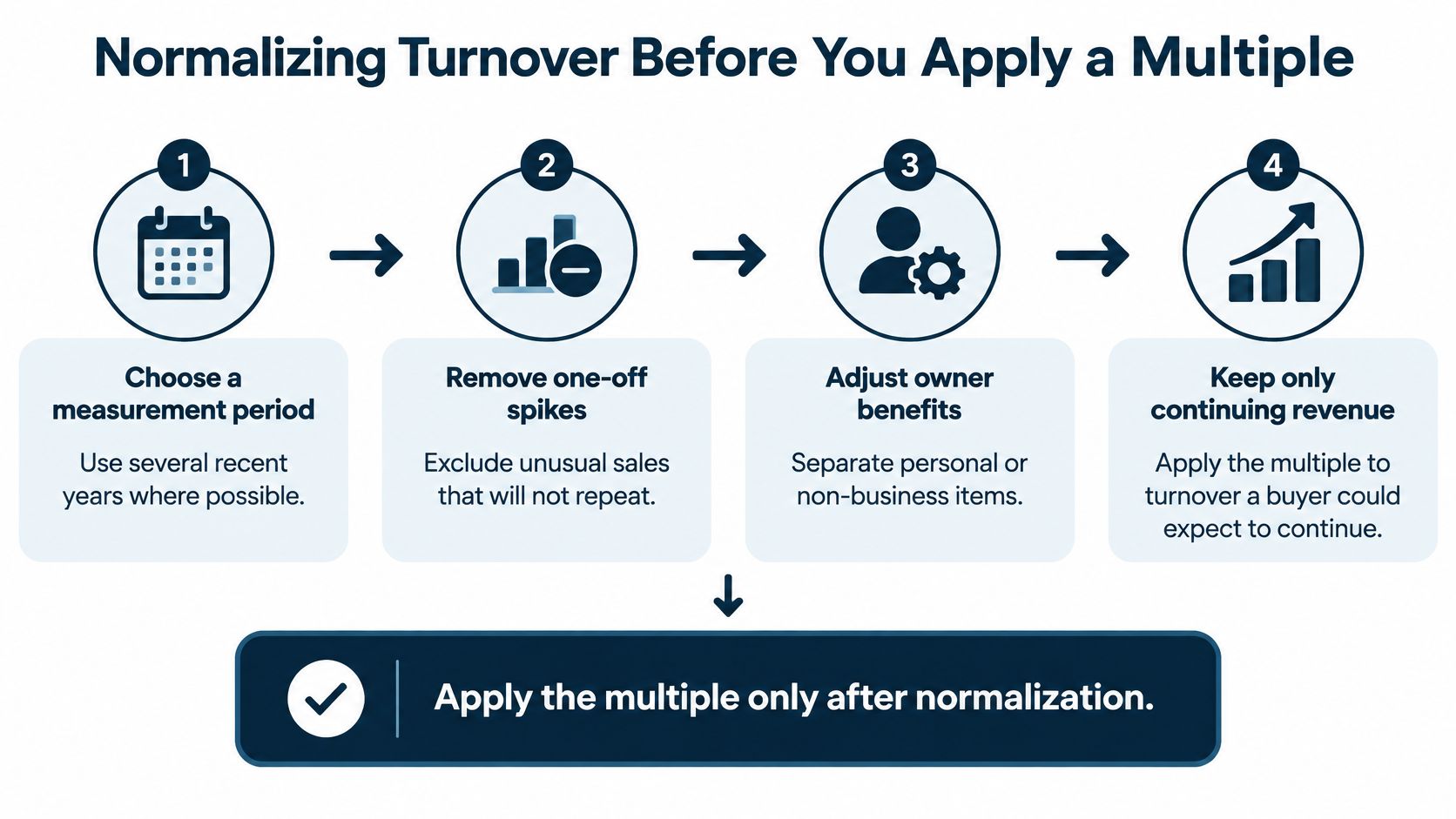
Six Normalization Steps
- Choose a measurement period. Use several recent years where possible so one unusually strong year doesn't set the price.
- Remove one-off contracts. Exclude unusual sales that are unlikely to repeat under new ownership.
- Strip out pass-through revenue. Money you collect and hand to a third party inflates turnover without adding equivalent profit.
- Adjust related-party pricing. Restate sales to family or affiliated entities at the rate an unrelated customer would pay.
- Remove discontinued operations. Revenue from a closed line or location isn't part of what the buyer acquires.
- Check accounting changes. A change in timing or classification can shift revenue between periods and distort the trend.
From Enterprise Value to What You Receive
Enterprise value is value attributable to debt and equity together. Equity value is what's left for owners after debt. The Damodaran U.S. EV-to-sales dataset reports ratios of approximately 1.03x for air transport, 2.53x for business and consumer services, and 5.78x for brokerage and investment banking.
In a labelled hypothetical, applying 2.53x to $5 million of normalized turnover indicates about $12.65 million of enterprise value. You then subtract debt and add excess cash and non-operating assets to reach equity value, before control or marketability effects.
Practical rule: Public-company multiples are a reference point, not a private-sale price. Don't import one without adjusting for scale, liquidity, and risk.
Checking Turnover Against Profit and Cash Flow
A turnover multiple produces a screening range. Before you treat any figure inside it as a price, reconcile that range to earnings, because identical revenue can support very different proceeds once margins enter the picture.

Research summarized in a Harvard Business School publication on industry multiples found EBITDA provides a better single basis for comparability than revenue multiples, with industry-multiple error standard deviations ranging from 12% to 120%.
An error spread that wide explains why buyers treat a revenue multiple as a first filter. When the turnover estimate and the earnings analysis land far apart, trust the earnings and find out why the gap exists.
The IRS valuation guidance recognizes three approaches for privately held businesses: the asset-based approach, the market approach, and the income approach. It also requires the selected benefit stream, such as revenue or cash flow, to be consistent with the multiple used. A turnover figure that cannot be traced to either profit or cash fails that test.
SDE, EBITDA and a Simple Stress Test
Seller's discretionary earnings (SDE) means pre-tax profit before owner pay above a market salary, interest, depreciation, amortization, and one-time items. It suits owner-operated firms. EBITDA means earnings before interest, taxes, depreciation, and amortization, and suits larger businesses with a management team in place.
Work in this order: calculate the turnover range, reconcile it to normalized SDE or EBITDA, then stress-test the margin assumption. In a hypothetical example, $3 million of turnover at a 12% normalized margin produces $360,000 of earnings. At 15%, it produces $450,000. A three-point margin change moves earnings by $90,000 before any multiple is applied, and whatever multiple the buyer eventually uses stretches that gap into a larger difference in price.
Then check the cash. Earnings absorbed by working capital, or that cannot cover acquisition debt, support a lower price than the multiple implies.
Keep several years of financial statements, tax returns, customer data, and normalized results so each assumption can be tested. Our breakdown of the standard business valuation formula and its inputs shows how those pieces connect.
When a Turnover Multiple Fits and When It Misleads
A bigger top line can be worth less. That isn't a paradox. It's what happens when sales cost too much to produce.

In a labelled hypothetical, a distributor with $10 million of turnover at a 4% margin keeps $400,000. A subscription business with $3 million at a 25% margin keeps $750,000, with revenue that renews. A buyer can rationally pay more for the smaller company.
| Business situation | Turnover multiple reliability | Check first |
|---|---|---|
| Recurring contracts with stable margins | Useful as a cross-check | Contract terms, churn and gross margin trend |
| Project-based work with uneven revenue | Weak on its own | Normalized revenue over several years and the backlog |
| Low-margin distribution at high volume | Can overstate value | Gross margin and working capital requirements |
| One customer making up a large share of sales | Unreliable without adjustment | Customer concentration and length of contract |
| Owner holds all key customer relationships | Overstates transferable value | Management depth and owner-specific add-backs |
| Revenue distorted by one-off or pass-through items | Unreliable until normalized | Remove one-off items before applying a multiple |
The Honest Trade-Off
- Speed: You get a first range quickly from one reported figure.
- Simple comparison: It helps you see where you sit against similar sold businesses.
- Margin blindness: It treats an expensive dollar of sales like a profitable one.
- Transfer risk: It can overstate value when customers follow you personally rather than the business.
Comparability is the test. Industry, geography, scale, profitability, and deal conditions should match, especially for Minnesota owners comparing against national data. Where assets dominate, review when an asset-based business valuation is more appropriate before relying on turnover at all.
How Lenders Limit a Turnover-Based Price
Revenue doesn't determine how much a buyer can borrow. Cash flow available for debt payments does, and lenders test it directly.
Summaries of SBA acquisition underwriting, including Nextax Advisory guidance on SBA acquisition underwriting, identify a minimum debt-service-coverage ratio of 1.25x for initial acquisitions under the referenced SBA rules. That means at least $1.25 of qualifying cash flow for each $1.00 of annual principal and interest. Ask your lender to confirm the current SBA standard operating procedure issue date before you rely on that figure.
In a hypothetical example, annual principal and interest of $150,000 requires about $187,500 of qualifying adjusted cash flow. Unsupported add-backs won't close a shortfall, and projections can't replace historical or properly adjusted historical support.
Independent Valuation and the Funding Gap
A summary of SBA financing requirements from KatzAbosch states an independent business valuation is generally required for acquisition financing, and identifies a $350,000 purchase-price threshold under the referenced 2026 framework, while earlier guidance commonly used $250,000. Confirm which version applies on your transaction date, including rules described as taking effect October 1, 2026.
For larger deals, Matthews' summary of new SBA lending requirements states initial acquisitions of at least $3 million, excluding specified owner-occupied real estate value, require a Quality of Earnings report in addition to an independent valuation under the referenced rules.
If supported value falls below contract price, the gap must come from somewhere. Buyers add equity, you provide seller financing, the price drops, or the structure changes. Consult a qualified lender and accountant early, while you still have options.
Common Questions and Next Steps
Is There One Revenue Multiple for My Industry
No. Ranges shift by sector, period, deal size, and profitability, so a single quoted figure is almost always the wrong starting point. Two businesses reporting identical turnover can sit in different ranges for every one of those reasons. Match comparable transactions to your business model and market before you accept any number.
Can Turnover Ever Be Reliable
Yes, as a market benchmark after you've normalized revenue and reconciled the result to profit and cash flow. It's reliable as a cross-check. It isn't reliable as the only evidence. A turnover figure cleaned of one-time items and supported by your tax returns can confirm a conclusion. Standing alone, it proves little.
How Do Value Asking Price and Final Sale Price Differ
Estimated value rests on stated assumptions. Asking price is your proposal to the market. Final sale price reflects what the parties agree after financing, debt, working capital, taxes, and terms. Earn-outs and deferred payments can shift your actual proceeds even when the headline number stays put.
Do I Need an Independent Valuation Before Selling
Not always, but SBA-financed acquisitions generally require one, and documented analysis sets realistic expectations either way. Ordered early, it surfaces a financing gap while you still have room to address it.
A high-turnover, low-margin business can be worth less than a smaller one with predictable recurring revenue. Price the cash, not the activity.
Documents to Gather First
Assemble these before you request a valuation. Each one feeds the normalization and cash-flow testing that a turnover figure alone can't provide.
- Financial statements: Three to five years, plus current year-to-date results.
- Tax returns: Matching years, reconciled to your internal statements.
- Customer data: Concentration, contract terms, and recurring revenue detail.
- Add-back schedule: Owner compensation and each adjustment, with documentation.
If you're in Minnesota, including the Minneapolis and St. Paul market, you can request a confidential valuation conversation with Mark Beaver at Exit Pathways. There's no promise of value, buyer, timing, or financing, and this article is educational, not legal, tax, accounting, or lending advice. Consult qualified professionals about your situation, and treat business valuation based on turnover as the cross-check it is.
If a revenue figure has been quoted to you as a price, Exit Pathways can help you test it against normalized earnings, cash flow, and what a lender will support before you go to market. Visit Exit Pathways to start that conversation in private.